This Content Is Only For Subscribers
With vital support from the Asian Development Bank, the National Cancer Control Program has successfully scaled up hands-on clinical training to all 20 districts, empowering local health workers to detect and manage head and neck cancers earlier and closer to home.
In a significant leap forward for public health infrastructure, the National Cancer Control Program (NCCP) under the Department of Public Health has successfully scaled up its specialized training for health workers across 15 districts, completing a nationwide rollout that brings life-saving cancer care to every corner of the Himalayan kingdom. Supported by the Asian Development Bank (ADB), this initiative marks a turning point in Bhutan’s battle against head and neck cancers, shifting critical diagnostic and management capabilities from central hospitals directly to community-level facilities.
Head and neck cancers—which include malignancies of the oral cavity, pharynx, larynx, and salivary glands—represent a substantial health burden in the region, often linked to factors such as tobacco and betel nut chewing, alcohol consumption, and the human papillomavirus (HPV). Historically, the rugged terrain and dispersed population of Bhutan meant that patients often had to travel long distances to the Jigme Dorji Wangchuck National Referral Hospital (JDWNRH) in Thimphu or the Eastern Regional Referral Hospital (ERRH) in Mongar for specialized care. By the time many cases were diagnosed, the cancer had reached an advanced stage, drastically reducing survival rates. The newly scaled-up initiative directly addresses this geographical and medical barrier by empowering local healthcare workers with the skills necessary to identify and treat these cancers in their nascent stages.
The recent expansion, funded and supported by the ADB, targeted health workers across 15 districts, building upon a successful pilot phase that initially covered 5 districts with the foundational support of the World Health Organization (WHO) Bhutan. With this final wave of training, the hands-on program has now reached all 20 districts of Bhutan.
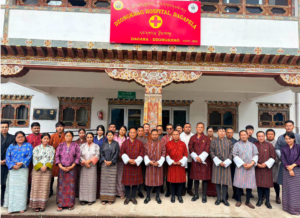
A central component of this capacity building has been the specialized clinical training provided to General Surgeons and General Duty Medical Officers (GDMOs). Through the ADB-supported program, these frontline medical professionals have received intensive, hands-on instruction in Fine-Needle Aspiration Cytology (FNAC) and punch biopsy techniques. FNAC, a minimally invasive diagnostic procedure used to investigate lumps or masses, and punch biopsies, utilized for diagnosing oral and throat lesions, are critical tools for early detection. By equipping district-level surgeons with these skills, patients can now receive rapid, accurate diagnoses without the burden of traveling to central hospitals, saving crucial time in the treatment pipeline.
To ensure the sustainability and uniformity of these new clinical standards, the ADB partnership also focused on the development of comprehensive educational resources. High-quality training videos and teaching aids were produced to standardize the instruction of healthcare professionals nationwide. These resources cover the entire spectrum of cancer management—from prevention and early detection to diagnosis and treatment protocols. By standardizing training, the Ministry of Health ensures that a patient in a remote eastern dzongkhag receives the same standard of preliminary care as a patient in the capital.
Recognizing that clinical intervention alone is insufficient to combat the rising tide of cancer, the initiative also placed a strong emphasis on community-driven advocacy. Cancer care is often shrouded in stigma and misinformation, leading to delayed presentations and poor outcomes. To combat this, the program actively engaged and equipped community health volunteers, cancer survivors, religious and community leaders, and even local celebrities and social media influencers with targeted advocacy skills. By training these influential figures, the NCCP has created a grassroots network of voices championing awareness about head and neck cancers. Religious leaders hold profound sway in Bhutanese society, and their involvement in demystifying cancer and encouraging early screenings is a culturally tailored approach to public health communication.
The success of this nationwide scale-up is a testament to the power of multisectoral collaboration. The Ministry of Health has publicly extended its deepest appreciation to the Asian Development Bank for its crucial financial and technical support in scaling up the program. Gratitude was also directed toward WHO Bhutan for its pivotal role during the pilot phase, which laid the groundwork for the current national rollout.
Furthermore, the Ministry highlighted the indispensable technical support provided by several specialized departments and institutions. The Department of Dental and ENT at JDWNRH, ERRH in Mongar, the Faculty of Nursing and Public Health (FNPH), and the Khesar Gyalpo University of Medical Sciences of Bhutan (KGUMSB) all contributed their expertise to shape the training curriculum and mentor local health workers.
At the local level, the seamless implementation of this training relied heavily on the administrative coordination provided by Dzongdas (district governors) and District Public Health Officers (DPHOs) / District Health Officers (DHOs) across the respective dzongkhags. Their localized support ensured that logistical hurdles were overcome and that health workers were able to attend and fully participate in the training modules.
The completion of this nationwide training initiative represents a major milestone in Bhutan’s healthcare journey. By decentralizing specialized skills and fostering community awareness, the country is building a robust defense against head and neck cancers.
“Together, we continue to strengthen cancer care, promote early detection, and improve access to quality health services across Bhutan,” the Ministry of Health stated in its official release. As the nation moves forward, this localized, well-equipped health workforce will stand as the first line of defense in ensuring that no Bhutanese citizen has to face a cancer diagnosis alone or without access to timely, quality care.