The Central Monastic Body has established the Monastic Institute for Language Studies in Wangdue Phodrang, enrolling its first seven monks in a two-year programme focused on English and Chinese as part of efforts to strengthen language, communication, interpretation and translation skills and help connect Bhutan’s Buddhist teachings with the wider world.
For Bhutan’s monks, learning foreign languages is increasingly becoming a way to connect the country’s Buddhist traditions with a wider world. A new institute established by the Central Monastic Body in Wangdue Phodrang is seeking to provide monks with the language and communication skills needed to engage with people beyond Bhutan and make Buddhist teachings more accessible internationally.
The Monastic Institute for Language Studies was formally inaugurated on Wednesday in Gase Tshogom Gewog, Wangdue Phodrang. It is the first dedicated language-learning programme established within the monastic body and will focus on language proficiency, communication, interpretation and translation.
The institute has started its first two-year programme with seven monks selected through an interview process. English and Chinese are the main languages being taught, with the students coming from different monastic backgrounds. Two of the students also have previous teaching experience.
Among the first batch is 37-year-old Dendup Dorji, who returned to being a student after serving as the Principal of Talo Sangngag Chholing Shedra in Punakha for three years.
Dendup resigned from his position to join the new programme, saying he saw language learning as an opportunity to contribute to the monastic body in a different capacity.
He is currently studying both English and Chinese and hopes the skills will allow him to communicate with people from different parts of the world and help connect Bhutan’s Buddhist tradition with an international audience.
“I resigned as the Principal of Talo Shedra and joined the institute as a student because I believe the institute can help us contribute to His Majesty’s vision for the Gelephu Mindfulness City and support the vision of the Zhung Dratshang,” Dendup said.
He said he hopes language skills will eventually allow him to serve as a bridge between Bhutan and the wider world.
For the students, the programme is not simply about learning vocabulary or improving spoken communication. They see language as a means of carrying knowledge gained through years of monastic education into a modern and increasingly interconnected world.
Sherub Namgyal, another student at the institute, said the programme offers an opportunity to learn international languages while maintaining a strong connection with traditional Buddhist studies.
He said English and Chinese could help monks communicate the teachings they have learned through their religious education to people from different linguistic and cultural backgrounds.
The students are being taught by Sean Weatherall, an American educator with several years of teaching experience who has also lived and worked in Bhutan.
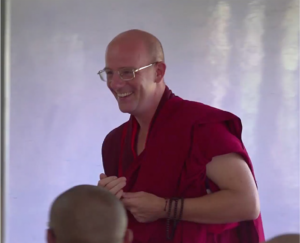
Weatherall said he has been impressed by the progress made by the first batch of students, particularly because their language learning is grounded in their existing monastic education.
He said the monks were not simply acquiring the ability to speak another language, but were also bringing the knowledge and wisdom developed through their religious studies into their communication.
He described language as a bridge that allows people to share their experiences and knowledge with others.
The institute was established against the backdrop of growing efforts to strengthen the international reach of Bhutan’s Buddhist heritage. As Bhutan develops new platforms for cultural and spiritual engagement, officials say monks with multilingual communication skills could play an important role in explaining and sharing the country’s religious traditions with international visitors and practitioners.
Kuenley Tenzin, President of the Monastic Institute for Language Studies, said the programme is particularly relevant to the spiritual vision associated with the Gelephu Mindfulness City.
He said the development of Dharma centres in Gelephu would create a need for people with the ability to communicate in multiple languages and expressed hope that the institute could help prepare younger generations of monks for that role.
The importance of language learning also extends beyond the proposed development of Gelephu. Bhutan’s Buddhist teachings have traditionally been preserved and transmitted through religious texts and oral instruction, much of which is rooted in classical and local languages.
As more international visitors, practitioners and researchers engage with Bhutan’s Buddhist institutions, the ability to communicate in widely spoken languages could help facilitate greater interaction while allowing monks to explain their traditions directly.
Chhador, Gase Tshogom Gup, said the responsibility of promoting Bhutan’s traditional religion should not rest solely with people from outside the country.
He said practitioners themselves need to develop the ability to communicate in other languages if Bhutan’s Buddhist traditions are to reach a wider international audience.
He views the new institute as an opportunity to strengthen that capacity and contribute to the future promotion of Buddhism beyond Bhutan.
For the seven students in the first batch, the two-year course therefore represents a shift from the conventional classroom experience within monastic institutions. They are learning new languages while drawing on years of religious education and experience.
The institute plans to increase its intake and introduce additional language programmes in the future, depending on available resources and funding.