Mental health conditions among older people in Bhutan often go unrecognized because symptoms such as memory loss, behavioral changes and sleep disturbances are dismissed as normal ageing, psychiatrists warned at the fourth PEMA Symposium in Thimphu, calling for greater awareness and stronger support as the country’s elderly population is projected to reach 118,650 by 2047.
Memory loss, changes in behavior and sleep disturbances among older people are often dismissed as signs of ageing, leaving many mental health conditions unrecognized and untreated. As Bhutan’s population grows older, psychiatrists are calling for greater awareness and stronger support systems to ensure older people receive timely care.
The issue was discussed at the fourth PEMA Symposium in Thimphu, where experts highlighted the challenges older people face in accessing mental health services.
Mental health support often focuses on younger people, while problems affecting older people may go unnoticed until their conditions become more serious. Psychiatrists say symptoms such as forgetfulness, irritability, changes in appetite, disturbed sleep and unexplained physical complaints can sometimes indicate underlying mental health conditions rather than simply being a consequence of growing old.
However, families and communities may overlook these signs, assuming that such changes are inevitable with age. This can delay diagnosis and prevent older people from receiving the treatment and support they need.
Experts describe this tendency as ageism, a form of discrimination in which people are treated differently because of their age. It can influence how older people perceive their own health problems and how society, institutions and governments respond to their needs.
Dr Palanimuthu Thangaraju Sivakumar, a geriatric psychiatrist with the National Institute of Mental Health and Neurosciences in India, said age-related assumptions could become a barrier to accessing care.
“It is one of the biases which can actually prevent care for older people. The bias can be within themselves or by others, whether it’s the government or society. So, anything that is happening to an older adult, something like a health problem or a mental health problem, they may attribute that to normal ageing,” he said.
The concern is particularly relevant for Bhutan as the country undergoes demographic changes. The number of people aged 65 and above is projected to increase from nearly 30,000 in 2005 to 118,650 by 2047.
Health officials recorded 6,449 cases of anxiety and depression among older patients in 2023. While the figures indicate that mental health concerns already affect older people, experts say awareness remains a challenge, particularly at the community level.
In some communities, changes in behavior and memory are still commonly understood as part of the ageing process rather than possible symptoms requiring medical attention.
Pema Yuden, Gewog Administrative Officer of Norbugang in Samtse, said people sometimes failed to recognize when older individuals needed professional help.
“Even though there are not many who are unconscious, some forget, and they tend to show different behaviors. We have always thought of it as part of ageing,” she said.
Local authorities can help provide shelter and social support to vulnerable older people, but their ability to address medical needs remains limited.
Haa Dzongrab Dorji Gyeltshen said officials work with relevant organisations when older people cannot care for themselves and have no family members to support them.
“If there are individuals who are mentally challenged and who cannot take care of themselves and get sick, we collaborate with RENEW. If he or she does not have anyone to look after them, there is GoenshoTshamkhang in Thimphu. We verify and let them stay there,” he said.
However, Bhutan has yet to establish a dedicated old-age psychiatry service. The PEMA provides occasional mental health support to older people at GoenshoTshamkhang in Thimphu, but experts say more comprehensive services will be needed as the population ages.
Without timely intervention, older people experiencing mental health conditions may continue to suffer without support. Their conditions could worsen, affecting their ability to manage daily activities and live independently.
Experts say the response should extend beyond medical treatment to include social care, community-based support and the use of technology to reach older people who may otherwise remain isolated.
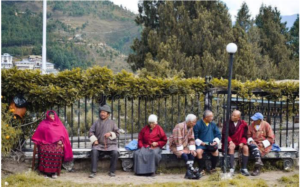
Dr Sivakumar said peer support and intergenerational programmes could help older people maintain social connections and receive support from different age groups. He also suggested establishing an elderly helpline linked to protection services, similar to existing helplines for children.
“Approaches like peer support and intergenerational interventions can be very useful here. Technology can also help, such as helplines. There is a child protection helpline, and similarly, an elderly helpline linked to elderly protection could be very useful. Older people need support for social care, and this will be important for supporting the ageing population,” he said.
Raising public awareness is another important step. Pema Yuden said mental health problems are often associated with younger people, while similar challenges among older people may be overlooked.
“Right now, people tend to think that mental health problems are all related to young people, whereby if they are drinking and smoking, we feel they are dealing with some mental health challenges. But if an older person drinks, smokes and stays like that, no one really understands why. So firstly, we need to understand that old people also have mental health problems,” she said.
Psychiatrist Dr Sonam Wangchuk said responsibility for supporting older people’s mental health should be shared across society, rather than left to healthcare professionals alone.
“Everybody can play a very important role in taking care of the mental health of the ageing population. That includes grassroots-level people like your family members, your local leaders, healthcare centres, NGOs, the Ministry of Health, universities; everyone has a very important role to play,” he said.
Families and neighbors are often among the first to notice changes in an older person’s behaviour or wellbeing. Recognising these changes and encouraging timely medical assessment could help ensure that potential mental health conditions are not dismissed as normal ageing.
Community leaders, healthcare centres, non-governmental organisations, universities and government agencies also have roles in improving awareness, strengthening support networks and helping older people access appropriate services.
As Bhutan prepares for a significantly larger elderly population in the coming decades, experts say recognising mental health problems early will be essential to protecting older people’s wellbeing, dignity and independence.