This Content Is Only For Subscribers
When a person is arrested or questioned in connection with a criminal offence, understanding basic legal rights can be as important as the questions being asked.
In countries such as the United States, England and Wales, and Australia, criminal justice systems have developed specific safeguards requiring suspects to be informed of certain rights before or during police questioning. The US system is widely associated with the Miranda warning, which includes the right to remain silent and the right to have a lawyer present during custodial interrogation.
England and Wales similarly provide detained people with access to free legal advice. Official guidance states that, when legal advice is requested, police are generally not permitted to continue questioning until the person has had an opportunity to consult a solicitor, subject to specified exceptions.
Bhutan has its own legal framework and terminology, but it also provides important safeguards for people facing criminal proceedings.
Article 7(21) of the Constitution provides that a person has the right to consult and be represented by a Bhutanese Jabmi of their choice. The Judiciary’s Justice Sector Strategic Plan also identifies this constitutional protection as a fundamental right.
The Civil and Criminal Procedure Code of Bhutan 2001 further provides that a person may defend themselves or be represented by a Bhutanese Jabmi of their choice. Where that right is waived, the waiver must be made competently and intelligently. Section 34 also provides for legal aid for an indigent accused where the interest of justice so requires.
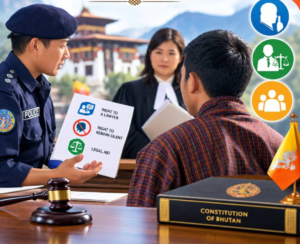
Importantly, the Code also addresses interrogation. It provides that interrogation of a suspect is permitted only after the person charged has been informed of the right to consult a Jabmi before interrogation.
The Evidence Act of Bhutan 2005 contains another significant safeguard concerning confessions. A confession must be voluntary and independent and must not result from duress, coercion, undue influence or inducement. When a confession is made to police, the law requires that the person first be warned that anything said may be used in legal proceedings, informed of the right to a Jabmi, and told that the Government will provide a Jabmi if the person cannot afford one.
These provisions show that Bhutan’s legal system already recognises the importance of legal representation and safeguards surrounding criminal confessions. The central issue, therefore, is not simply whether the right exists in law, but whether ordinary people understand that right and know when and how to exercise it.
For someone unfamiliar with the law, being arrested or questioned can be an unfamiliar and stressful experience. Legal terminology and criminal procedure can also be difficult to understand without assistance. This makes awareness of the right to consult a Jabmi particularly important.
Bhutan’s Judiciary has also developed practical mechanisms to recognise the right to legal representation. Its published judicial forms include a “Right to Jabmi” form and a “Waiver of Right to Jabmi” form, reflecting the formal recognition of the right within court proceedings.
The comparison with other jurisdictions nevertheless highlights an area worthy of continued public discussion. The US Miranda framework specifically requires warnings concerning silence and counsel before custodial interrogation, while England and Wales have detailed procedures governing access to legal advice during detention and questioning.
Bhutan’s framework is structured differently. Its laws expressly address the right to consult a Jabmi before interrogation and impose safeguards concerning the admissibility of confessions. It would therefore be inaccurate to describe Bhutan as simply lacking a Miranda-style protection. The more useful question is how effectively existing safeguards are communicated and understood by people who encounter the criminal justice system.
Greater public awareness could help give practical meaning to rights that already exist in law. Clear information about the right to consult a Jabmi could be displayed at appropriate points in police and judicial facilities. Explanations could be provided in language that ordinary people can understand, with interpretation or translation where necessary.
Legal awareness is particularly important because the right to counsel is not limited to courtroom representation. Bhutanese law expressly recognises the right to consult a Jabmi before interrogation, while the Evidence Act places specific requirements on police confessions.
The Jabmi Act also assigns the Jabmi Tshogdey responsibilities that include promoting legal education and organising legal aid for indigent persons through pro bono arrangements.
The broader principle is straightforward: rights are most meaningful when people understand them.
Bhutan has established constitutional and statutory protections concerning legal representation, interrogation and confessions. The continuing challenge is ensuring that these safeguards are accessible and understood by people at the point when they need them.
The idea behind a Miranda warning, therefore, offers Bhutan a useful point of comparison—not a legal model to be copied wholesale, but an opportunity to examine how information about fundamental rights is communicated during the earliest stages of criminal proceedings.
For an accused person, knowing that the law provides a right to consult a Jabmi can make an important difference. For the justice system, ensuring that this right is clearly understood can strengthen public confidence in fair and transparent legal processes.
The right exists in law. The next question is how effectively people are enabled to understand and exercise it.