Regional training in Yusipang focuses on tomato and chilli hybrid seeds, with the aim of improving farmers’ access to quality planting materials and strengthening food security
Bhutan is strengthening its technical capacity in hybrid vegetable seed production, with agricultural researchers receiving specialised training aimed at improving seed quality and reducing reliance on imported supplies.
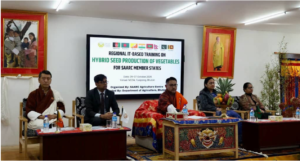
The three-day regional programme, held from 5 to 7 October at the National Centre for Organic Agriculture (NCOA) in Yusipang, brought together researchers and agricultural experts from South Asian Association for Regional Cooperation (SAARC) member states to develop skills in producing hybrid seeds, particularly for tomato and chilli.
The Department of Agriculture under the Ministry of Agriculture and Livestock organised the training in collaboration with the SAARC Agriculture Centre (SAC), Dhaka, Bangladesh. The programme was conducted in a hybrid format, with 30 Bhutanese researchers attending in person and participants from Bangladesh, India, Nepal and Sri Lanka joining virtually.
Agriculture and Livestock Minister Lyonpo Younten Phuntsho inaugurated the programme, which also brought together Tanvir Ahmad Torophder, Director of the SAARC Secretariat in Kathmandu, as the special guest, alongside diplomatic representatives and officials from Bhutan’s agriculture and foreign affairs agencies.
The training focuses on practical techniques that researchers can apply to improve the quality and reliability of hybrid vegetable seeds.
According to the Department of Agriculture’s programme information, the sessions cover parent plant management, emasculation, pollination, genetic purity, seed handling, storage and quality control. Participants also take part in technical lectures, laboratory exercises, field demonstrations and group learning.
These techniques are important in hybrid seed production, where carefully selected parent plants are crossed to combine desirable characteristics. Proper pollination and genetic purity management help maintain the intended qualities of the resulting seeds, while appropriate handling and storage support seed quality.
In a report published on 5 October, Bhutan Broadcasting Service (BBS) quoted Saha Bir Rai, Chief Agriculture Officer with the Department of Agriculture, explaining that Bhutan has basic knowledge and experience in hybrid seed production but needs more advanced technical expertise.
The training seeks to address that gap by strengthening the knowledge of researchers and agricultural professionals who can apply and share their skills through future research and field-level support.
For farmers, access to quality seed is an important starting point for vegetable production. Seeds with suitable characteristics can help farmers establish crops more consistently and improve the quality and uniformity of their produce when combined with appropriate cultivation practices.
The organisers expect stronger regional capacity in hybrid seed production to improve the availability of quality planting materials and help reduce dependence on imported hybrid seeds.
For Bhutan, developing local expertise could also provide greater scope to research varieties suited to the country’s farming conditions. Better coordination between research institutions and agricultural extension services could help transfer improved production techniques to farmers.
These benefits will depend on how the training is followed up. Researchers will need opportunities to apply their knowledge through trials, evaluate seed performance and ensure that suitable planting materials reach farming communities. The programme itself does not establish that seed imports have already declined or that farmers’ incomes and yields have increased.
Vegetables contribute essential vitamins, minerals and dietary fibre to people’s diets. Improving the reliability of vegetable production can therefore support Bhutan’s wider food and nutrition security objectives.
The training also highlights the importance of preparing agriculture for challenges associated with climate variability, pests and diseases. During the inaugural session, Lyonpo Younten Phuntsho emphasised the role of plant breeding, hybrid vigour and quality seed systems in strengthening agricultural productivity and resilience.
He also stressed that investment in research, seed technology and human resources should translate into practical benefits for farmers, including better yields, reduced production risks, improved market opportunities and stronger livelihoods.
Achieving those outcomes requires more than technical training. Continued research, effective quality control, suitable varieties and reliable distribution systems will be essential to ensure farmers can access and use the seeds successfully.
The Yusipang programme creates an opportunity for Bhutanese researchers to learn alongside experts from other SAARC member states and strengthen regional cooperation in agricultural technology.
Its long-term value will depend on whether participants translate the knowledge gained into practical research and support for farmers. By building local expertise in hybrid seed production, Bhutan can work towards a more reliable supply of quality planting materials and strengthen the foundations of vegetable production.
The next step is to carry these techniques from training facilities and demonstration fields into farming communities, where their contribution can be assessed through seed quality, crop performance and farmers’ access to improved planting materials.