Around 38 community resource persons from 21 gewogs are being trained in climate-smart agriculture in Monggar as Bhutan steps up efforts to help farmers in eastern regions respond to unpredictable rainfall, floods, damaging storms and emerging crop pests and diseases, while working towards food self-sufficiency by 2029.
Farmers in eastern Bhutan are increasingly facing unpredictable rainfall, damaging storms, floods and emerging crop pests and diseases. To help communities respond to these challenges, the Department of Agriculture is training local resource persons to promote climate-smart farming and strengthen support for farmers at the gewog level.
Around 38 community resource persons from 21 gewogs are attending a three-day training programme in Monggar. The initiative aims to establish a network of trained individuals who can help farmers adapt to changing weather patterns, improve agricultural practices and sustain food production.
The resource persons are expected to work alongside agriculture extension officers, helping farmers access technical information, government services and other resources needed to manage climate-related risks.
Tshetrim La, Deputy Chief Agriculture Officer at the Ministry of Agriculture and Livestock, said eastern Bhutan has been particularly affected by climate-related disasters, with damage to farmland and crops reported in recent years.
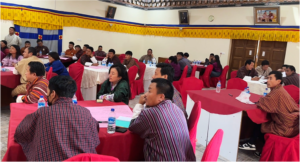
“The eastern region is the most affected by climate change-related impacts. This has been reported in media houses, and we have a division looking after such disasters. Every year, we receive reports of floods damaging fields, storms destroying crops, and the emergence of new pests and diseases. To address these challenges, we are training the community resource persons with the expectation that they will play an effective role,” he said.
The training covers several aspects of climate-smart agriculture, including climate resilience, sustainable food production, nutrition, market access, value addition and crop diversification.
These areas are intended to help participants understand how farming practices can be adapted to changing climatic conditions while supporting more sustainable agricultural production.
The programme also seeks to address gaps in agricultural
services, particularly in gewogs where there are not enough officers to provide regular assistance to farmers.
According to Tshetrim La, some agriculture extension officers are responsible for serving two gewogs, limiting the support available to farming communities.
“Currently, gewogs face a shortage of extension officers, with a single officer often responsible for covering two gewogs in some regions. These participants will complement the extension officers in the gewogs. They will serve as influential figures within the communities, helping residents in accessing vital information such as seed centres and other relevant offices,” he said.
By developing local resource persons, the department hopes to improve the flow of agricultural information between government services and farming communities. Having trained individuals within villages could also help farmers better understand available support and respond more effectively when their crops are threatened.
For participants, the training comes at a time when the effects of extreme and unpredictable weather are already being experienced in their communities.
Kezang Jamtsho, a participant from Minjey Gewog in Lhuentse, said a recent storm caused damage to farms in his village, leaving farmers uncertain about how to respond.
“Just recently, a powerful storm wreaked havoc on our farms back in our village. We did not know what was causing it. During such events, we do not know how to react. The training is teaching us how to manage our farms to prevent such disasters. We are grateful,” he said.
In Narang Gewog, Monggar, farmers have also experienced changing weather conditions affecting their crops.
Dechen Choden, a participant from the gewog, said irregular rainfall, strong winds and floods had damaged maize and other agricultural activities in her village.
“Our village experienced erratic rain, strong winds destroying our maize, and floods. Until now, we were not aware and thought they were natural events. From this training, we understood that these are climate-change induced patterns,” she said.
Another participant from Narang, Tshering Dukar, said the programme had helped participants better understand the effects of climate change on agriculture, including the importance of knowing when to harvest crops.
“We have learned when to harvest our crops. Moreover, through this training, I was able to learn that climate change is causing erratic downpours, droughts, and windstorms,” he said.
Understanding these risks is important for farmers who depend on weather conditions to determine planting, crop management and harvesting schedules. Unpredictable rainfall, droughts and windstorms can disrupt these activities, damage crops and threaten the income and food supply of farming households.
The programme’s emphasis on crop diversification, sustainable production and climate resilience is intended to help communities strengthen their capacity to manage such challenges.
Community resource persons are expected to complement, rather than replace, agriculture extension officers by helping farmers access information and connect with relevant services. Their effectiveness will depend on how well they can apply the training in their communities and work with existing agricultural support systems.
The initiative also contributes to Bhutan’s broader effort to achieve food self-sufficiency by 2029. Strengthening farmers’ capacity to respond to climate risks is an important part of maintaining agricultural production and reducing disruptions to food supplies.
The Food and Agriculture Organization of the United Nations is implementing the programme with funding support from the Global Environment Facility’s eighth funding cycle, under the GEF-8 Food System Programme.
As climate-related challenges continue to affect farming communities, the initiative aims to equip local resource persons with the knowledge to help farmers adapt their practices, protect crops and sustain